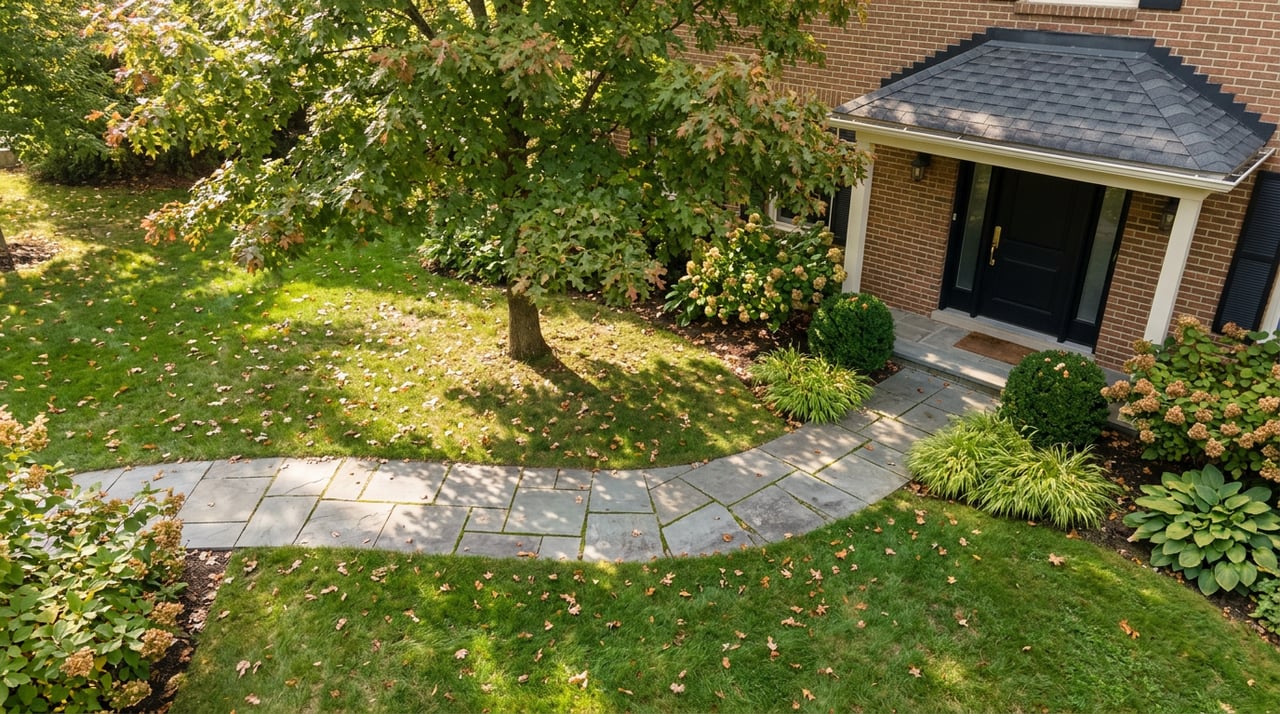
The Tree Permit That Can Quietly Delay Your Oakville Listing
August 27, 2026
August 27, 2026
A seller in South East Oakville called her arborist in early July with a simple request: take down the silver maple crowding the front window before the photographer arrived. She had budgeted three days for pruning and touch-up landscaping. She got a six-week wait instead, and a line item in her closing paperwork she hadn't planned for.
That gap between what sellers expect and what actually happens is the reason this post exists. Oakville regulates private tree removal more tightly than most sellers assume, and the rule that catches people off guard isn't the permit itself. It's what happens after the tree is gone.
Any tree on private property in Oakville with a trunk 15 centimetres or more in diameter, measured at chest height, is protected under the Town's Private Tree Protection By-law. That threshold is smaller than it sounds. A maple, oak, or spruce that's been in the ground for even a decade or two will typically clear it. Hedges count too, if the individual stems measure 15 centimetres or more.
If you're planning to remove a mature tree to open up curb appeal, clear a sightline for staging photos, or take down something a buyer flagged during a showing, you likely need a permit before a chainsaw touches it. Oakville requires an on-site consultation with a town tree inspector as part of that process, and the permit itself costs $182. A handful of situations skip the fee, including dead or high-risk trees, ash trees, and buckthorn, though a permit is still required even when the fee is waived.
This is worth sitting with for a moment, because it's not how tree removal works in a lot of the GTA. Many sellers who've prepped a listing in a neighbouring municipality assume a tree on their own property is theirs to deal with on their own timeline. In Oakville, it isn't. About half of the town's urban forest sits on private land, and the by-law treats that canopy as a shared asset the town has a say over, not just a landscaping feature.
Here's where the six-week gap comes from. After you apply, the town schedules a site visit and an inspector assesses the tree. If approved, you're required to post the permit visibly on the property for five days before removal can begin. Once that window closes and you've hired a qualified arborist to do the work, the town's own guidance says removal and stump grinding can take up to four weeks to complete.
Add it up: consultation, approval, the five-day posting requirement, then up to four weeks for the physical work, and you're looking at a process that can run six to eight weeks from application to a cleared lot. If you're planning a listing for a specific week to catch a seasonal market window, that's not a detail to discover after your photographer has already booked the shoot.
If the tree sits near a property line, add one more step. Oakville's process calls for a signed letter of consent from the adjacent property owner in those cases, which means a conversation with a neighbour has to happen before the town will move your file forward.
This is the piece most pre-listing checklists miss entirely, because it isn't really about removal. It's about what the town requires afterward.
Permits are issued on the condition that the applicant covers the cost of removal, stump grinding, and replacement planting. That third piece is where the timeline stops being under your control. Replacement planting in Oakville is tied to the seasons, not to your closing date: a tree removed in spring gets its replacement planted the following fall, and a tree removed in any other season gets its replacement planted the following spring.
Picture the seller from the opening of this post. She removes her maple in July to get ready for a late-summer listing. Under the town's own timing rule, the replacement tree doesn't go in the ground until the following spring, six to nine months after her closing date. The permit obligation was hers when she applied for it. If the sale closes before the replacement is planted, the question of who's actually responsible for finishing that condition, and who pays for it, becomes something that needs to be addressed directly in the transaction rather than assumed away.
This is precisely the kind of detail worth raising with your real estate lawyer before you sign anything, not after. A tree permit that's still technically open at closing is a loose thread, and loose threads are exactly what a well-drafted agreement of purchase and sale is supposed to catch. It's also worth mentioning to your agent early, since a pending replacement obligation is the kind of thing better disclosed and resolved than discovered by a buyer's lawyer during the review period.
It would be easy to treat all of this as bureaucratic friction that nobody actually polices. Oakville's own by-law page states that non-compliance can lead to fees and charges under the town's Administrative Penalty By-law, and the town has shown it's willing to use that authority.
The most dramatic recent example wasn't a typical seller situation. It involved the unauthorized demolition of a designated heritage home in 2025, where a court ultimately imposed $822,000 in penalties, with charges that included violations of the town's tree protection by-law alongside building code and heritage act violations. That case is an outlier in scale, tied to a heritage property and an unpermitted demolition, not a homeowner trimming a maple before a listing. But it tells you something useful: Oakville treats its tree protection rules as enforceable law, not a suggestion, and the town has both the legal mechanism and the willingness to act on it.
For an ordinary seller, the realistic risk isn't a headline-making penalty. It's an unpermitted removal getting flagged, either by a neighbour or during the town's own review process, and then having to resolve that after the fact instead of before, on a timeline you no longer control.
If you're planning to sell a home in one of Oakville's mature-canopy pockets, places like South East Oakville, Glen Abbey, River Oaks, or Bronte Village, where established trees are often part of what gives a property its curb appeal in the first place, the practical move is to treat any tree decision as a permitting question before you treat it as a landscaping one.
A few things worth doing 60 to 90 days out from a planned listing date:
None of this is about avoiding the by-law. It's about not letting a town process with its own calendar collide with a sale that's running on yours.
Does this apply to a tree I want to remove just for staging photos, not because it's dead or damaged? Yes. The by-law applies based on trunk size, not the reason for removal. A healthy tree removed purely for curb appeal or sightlines needs the same permit as one removed for safety.
What if the tree is already dead or clearly hazardous? Dead and high-risk trees, along with ash and buckthorn, still require a permit but are exempt from the fee. The inspector can issue the permit on site during the consultation in these cases.
Can I just remove a small hedge without going through this process? Individual hedge stems under 15 centimetres in diameter fall outside the by-law. Once stems reach that threshold, the hedge is treated the same as a tree.
What happens if a buyer specifically asks for a tree to be removed as a condition of the offer? That request doesn't bypass the town's process. The permit, timeline, and replacement obligation still apply, which means it needs to be built into the conditions and closing date in the agreement itself, not treated as a quick pre-closing task.
Getting the timing right on something like this is exactly the kind of detail that separates a smooth listing prep from a scramble. If you're planning a sale in Oakville and want a pre-listing calendar that accounts for permits like this one before they become a problem, Team Durrani is a call away. Schedule a consultation and we'll walk your specific property, timeline, and tree line before you book a single appointment.
Stay up to date on the latest real estate trends.
Whether you're buying, selling, or investing, Team Durrani is ready to provide the expertise and dedication you deserve. Contact us today to begin a professional, transparent, and results-driven real estate journey.
Team Durrani
Address
17-1075 North Service Rd. W
Oakville, Ontario, L6M 2G2